Available dimensions
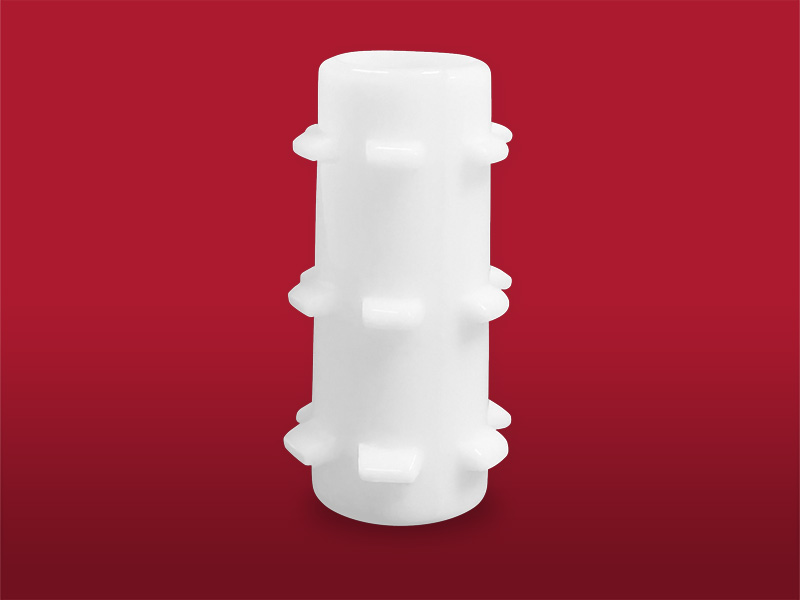
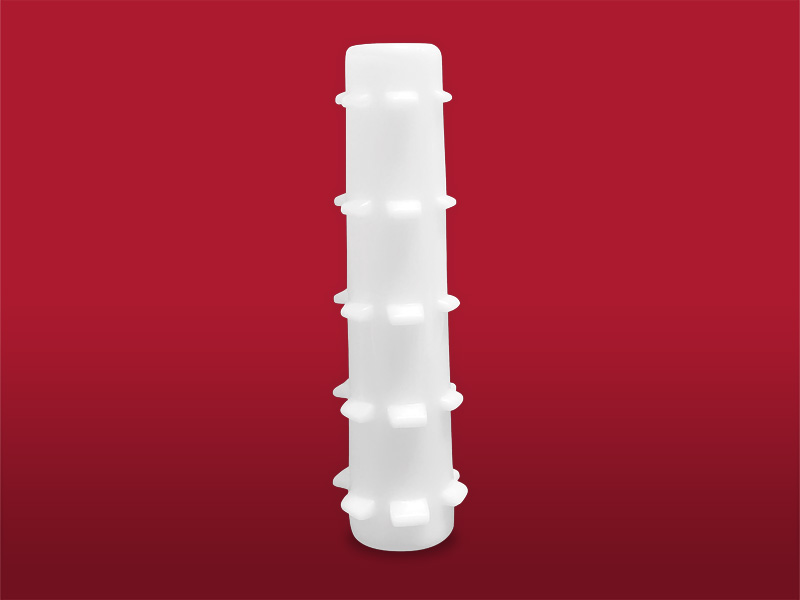
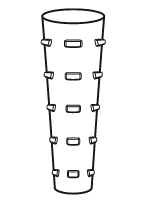
The Stening® Class is offered in a wide range of sizes, with diameters from 10 to 14 mm and lengths from 30 to 50 mm. The code indicates the diameter and length (for example, CLASS 12-40 corresponds to a 12 mm diameter and a 40 mm length).
| Code | Diameter | Length |
|---|
| CLASS 10-30 | 10 mm | 30 mm |
| CLASS 10-40 | 10 mm | 40 mm |
| CLASS 10-50 | 10 mm | 50 mm |
| CLASS 11-30 | 11 mm | 30 mm |
| CLASS 11-40 | 11 mm | 40 mm |
| CLASS 11-50 | 11 mm | 50 mm |
| CLASS 12-30 | 12 mm | 30 mm |
| CLASS 12-40 | 12 mm | 40 mm |
| CLASS 12-50 | 12 mm | 50 mm |
| CLASS 13-30 | 13 mm | 30 mm |
| CLASS 13-40 | 13 mm | 40 mm |
| CLASS 13-50 | 13 mm | 50 mm |
| CLASS 14-30 | 14 mm | 30 mm |
| CLASS 14-40 | 14 mm | 40 mm |
| CLASS 14-50 | 14 mm | 50 mm |
All sizes are always available. For specific inquiries about instrumentation, bronchoscopes or introducers, contact us at (+54) 11 4553-5070 or (+54) 11 4551-2333.
Introduction technique
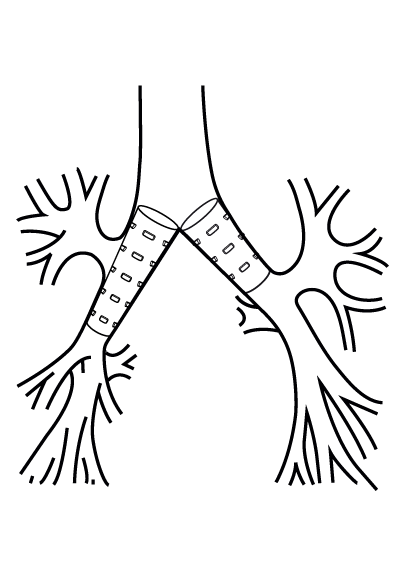
The procedure is carried out under general anesthesia. The implantation of this type of prosthesis requires the use of a conventional introducer for silicone prostheses. The airway is accessed with a rigid bronchoscope.
The length and lumen of the trachea or bronchus in the segment where the stent will be placed must be estimated in order to make the correct choice of prosthesis.
Retrograde implantation mode
- Lubricate the introducer nozzle, avoiding that the lubricant reaches the operator’s fingers.
- Fold the Stening® Class along its axial axis and insert it into the prosthesis introducer through the nozzle, with the narrowest end of the stent in the distal position.
- Remove the nozzle.
- Pass beyond the lesioned area with the bronchoscope tube and place its distal end or bevel over the healthy mucosa, exceeding the affected zone by about 5 to 7 mm.
- Place the introducer inside the bronchoscope.
- Press the ejector while withdrawing the bronchoscope by the same amount as the plunger advances inside it.
The prosthesis is thus released. If necessary, it can be adjusted with alligator forceps, the maneuver being simpler if the stent lies more “below” the lesion.
Anterograde implantation mode
Steps 1, 2 and 3 are repeated. Now stop the bronchoscope containing the introducer and the prosthesis 5 mm before the lesion to be treated, and then slowly press the ejector plunger. In this way the prosthesis will advance into the bronchial area to be treated.
A prosthesis loader may be used to then push it through the interior of the bronchoscope, or whatever method the operator deems preferable.
Correcting the stent position
The stent may require additional maneuvers in order to correct or adjust its final position. It is preferable to correct a stent that has been placed beyond the desired position than the reverse, since it is highly inconvenient to advance a prosthesis that has been released before the lesion to be treated.
To move a stent proximally, it can be grasped by the edge and gently pulled. We strongly recommend, for its precision, a maneuver consisting of grasping the stent by its edge as mentioned, and then introducing the direct-vision optics inside the stent and observing its end. Now pull the forceps and you will be able to verify the ascent of the stent within the bronchus. Stop the traction when you believe the stent position is optimal.
Removal technique
Intubation is performed with a rigid bronchoscope. Easy to remove, the stent should be grasped by its edge with alligator-type forceps, firmly enough. Rotate the forceps so that the stent takes on an omega shape and loses its radial resistance to compression. Then pull the forceps, extracting the prosthesis together with the bronchoscope. If preferred, the end of the stent can be introduced inside the endoscope; with this maneuver the vocal cords are protected during removal.